The Ultimate Hume Health Product Review: Is the Body Pod and Band Worth?
An in-depth, honest Hume Health review. Discover the features, pricing, pros, cons, and accuracy of the Hume Health Body Pod and Band before you buy.
By Joseph White
Published Aug 6, 2026
The smart health industry has evolved dramatically over the last few years. Tracking your health is no longer just about stepping on a scale to see a single number or checking how many steps you walked before dinner. Modern wellness trackers look deeper into biometric data, tracking longevity, body composition, and metabolic momentum.
Hume Health has emerged as a major player in this specialized space, promising an ecosystem that bridges the gap between commercial tech and professional fitness evaluation. Their flagship products—the Hume Health Body Pod and the Hume Health Band—aim to provide actionable physiological insights without the need for expensive, recurring clinical appointments.
However, with aggressive social media marketing campaigns and bold claims of "98% accuracy compared to clinical DEXA scans," it is natural to feel a bit skeptical. Is Hume Health a revolutionary step forward for proactive health management, or is it just high-tech marketing wrapping up basic sensors?
This comprehensive, unsponsored review breaks down the features, real-world user experience, pricing, pros, cons, and competitor comparisons to help you make an informed decision.
What is Hume Health?
Hume Health is a longevity and wellness technology brand focused on preventative health tracking. Instead of focusing exclusively on weight loss or calorie counting, the company leans heavily into tracking biometrics to lower your biological age, improve metabolic performance, and minimize health risks.
Rather than functioning as isolated gadgets, their products function as a cohesive ecosystem powered by the centralized Hume Health App. The core philosophy rests on providing an "AI health coach in your pocket," translating highly technical metrics like Heart Rate Variability (HRV), visceral fat levels, and metabolic capacity into clear, daily habit adjustments.
The Product Lineup
- The Hume Health Body Pod: A smart body composition analyzer disguised as a sleek scale. It uses advanced multi-frequency Bioelectrical Impedance Analysis (BIA) via 8 distinct tactile electrodes to map your muscle mass, fat distribution, and hydration status across different segments of your body.
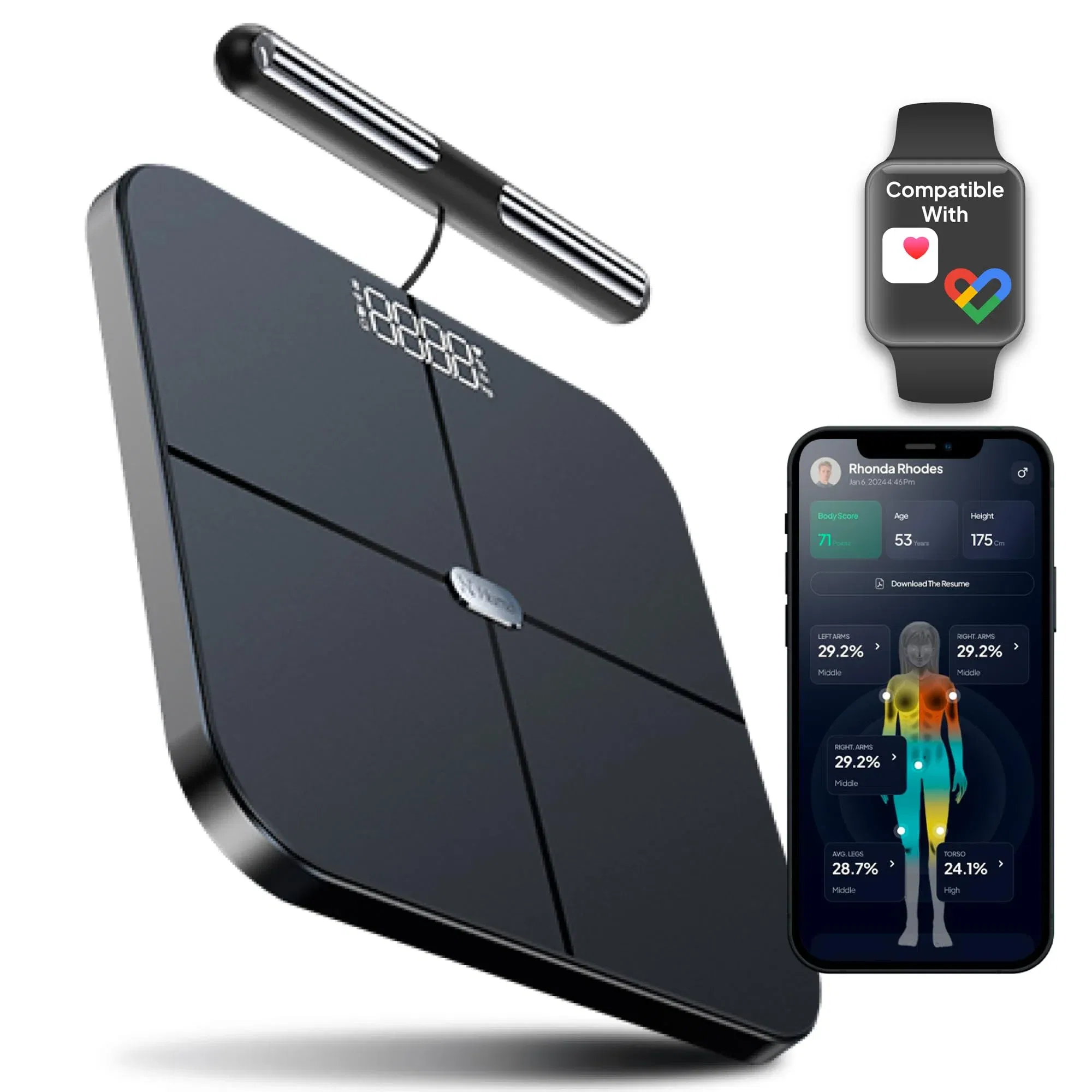
- The Hume Health Band (and the newer Band 2.0): A screenless, lightweight health tracker worn on the wrist. Designed to track cardiovascular strain, sleep cycles, recovery states, and early signs of physiological inflammation, it competes with well-established devices like the WHOOP band and the Oura Ring.

Products Key Features
To truly evaluate Hume Health, we need to lift the hood and look closely at what these devices track and the technology they utilize to collect that data.
1. Hume Health Body Pod Features
The Hume Health Body Pod goes far beyond what a typical $30 digital scale offers. It utilizes a segmental analysis method. Most standard smart scales only pass an electrical current through your feet, meaning they only estimate the lower half of your body and use algorithmic guesswork for the rest. The Body Pod features a pull-up handle with integrated hand electrodes, creating a full closed-loop system that measures arms, legs, and your torso independently.
- 48 Structural Body Metrics: Tracks key markers including skeletal muscle mass, visceral fat rating, subcutaneous fat, intracellular and extracellular water levels, and bone mass.
- Metabolic Age Calculation: Compares your base metabolic output and lean muscle status against general demographic averages to estimate whether your body is running "younger" or "older" than your chronological age.
- Segmental Lean Mass Mapping: Visually charts out muscle distribution across your left arm, right arm, left leg, right leg, and trunk. This is highly beneficial for athletes recovering from injuries or individuals addressing strength imbalances.
2. Hume Health Band Features
The Hume Health Band focuses on continuous, passive monitoring. Because it lacks an interactive screen, it minimizes digital distractions while maximizing battery efficiency, sending all collected data directly to your companion app via Bluetooth.
- Continuous Biometric Capturing: Features an optical array containing 5 LEDs and 4 photodiodes to record heart rate, blood oxygen levels ($SpO_2$), respiratory rate, and skin temperature fluctuations 24/7.
- Metabolic Momentum & Capacity Scores: Algorithms analyze your movement density, training loads, and cardiovascular response to assign you a dynamic daily metabolic efficiency rating.
- Advanced Predictive Insights (Premium Feature): The underlying companion software tracks subtle multi-week variations in your baseline inflammation and HRV data to alert you of potential illnesses or overtraining exhaustion up to 48 hours before physical symptoms materialize.
User Experience and App Interface
A smart health tracker is only as good as its software experience. If a device throws dozens of complex data charts at you without context, it quickly ends up collecting dust in a closet.
Connecting both the Body Pod and the Band via the Hume Health App is relatively straightforward. The app features a clean, dark-themed dashboard that bypasses complex medical jargon in favor of simplified, color-coded health scores.

Daily Adjustments and Coaching Nudges
When you wake up, the app synthesizes your sleep cycles, resting heart rate, and overnight temperature changes into a single Daily Health Score. If your recovery score drops abnormally low, the app provides a proactive coaching tip, such as suggesting a lighter active-recovery walk or recommending a specific adjustment to your evening hydration routine.
Real-World Friction Points
While the interface is visually clean, the long-term user experience reveals some operational issues. Multiple users report that the scale can occasionally be stubborn during its initial Bluetooth sync, sometimes requiring you to step on the platform multiple times or restart your smartphone app to force a recording to register.
Additionally, because the data processing happens locally within your app to maintain privacy, switching between multiple devices (like an iPhone and an iPad) can sometimes cause gaps in your historic tracking timeline if the sync cycles get interrupted.
Pricing & Plans
Hume Health uses a hybrid monetization strategy combining an upfront hardware purchase with an optional, premium software subscription.
- The Hume Health Body Pod Price: Typically retails between $249 and $349 depending on seasonal promotional bundles.
- The Hume Health Band 2.0 Price: Retails around $249, though discounts frequently bring the entry price down closer to $199.
The Subscription Dilemma: Hume Plus vs. Free Base App
Unlike competitors that completely lock your device behind a mandatory paywall, Hume Health includes a robust Free Base Plan that allows you to track your core metrics, weight trends, and basic daily health scores without a monthly fee.
| Tier | Price | Included Features | Target User |
| Base App | Free | Weight, standard body fat, basic muscle mass, daily HRV, sleep time | Budget-conscious users tracking basic trends |
| Hume Plus Membership | $8.99 / month | Segmental analysis, predictive illness alerts, metabolic capacity tracking, AI coaching | Advanced fitness enthusiasts & longevity trackers |
Pros and Cons
To provide a clear, balanced picture, let's look at the practical advantages and disadvantages of bringing the Hume Health ecosystem into your daily routine.
Advantages & Disadvantages Breakdown
- Pros:
- Comprehensive full-body segmental analysis via integrated handbar electrodes.
- No strict mandatory subscription required to view core metric trends.
- Screenless wearable design minimizes digital distractions and blue-light exposure.
- Broad integration support with Apple Health, Google Fit, and Samsung Health.
- Long battery life on the Band 2.0 (lasting up to a week per charge).
- Cons:
- Upfront retail pricing is relatively high compared to standard consumer alternatives.
- Occasional app connectivity glitches during automated morning weigh-ins.
- Wearable sleep staging can show variance when compared to dedicated smart rings.
- Rigid corporate return policies make processing refunds time-consuming if you change your mind.
Comparison with Competitors
How does Hume Health hold up against established fitness and smart tracking brands? Let's take an objective look at how the Body Pod and Band stack up against industry benchmarks.
Smart Scale Comparison: Hume Body Pod vs. Alternatives
| Metric/Feature | Hume Health Body Pod | Withings Body Comp | InBody H20N |
| Upfront Price | ~$249 - $349 | ~$199 | ~$349 |
| Measurement Method | 8-Electrode Segmental | 4-Electrode Foot Only | 8-Electrode Segmental |
| Handlebar Included | Yes | No | Yes |
| Visceral Fat Tracking | Yes | Yes | Yes |
| Mandatory Paywall | No | No | No |
Wearable Tracker Comparison: Hume Band vs. Industry Leaders
| Feature | Hume Band 2.0 | WHOOP 4.0 | Oura Ring 4 |
| Form Factor | Screenless Wristband | Screenless Wristband | Smart Ring |
| Subscription Cost | $0 (Optional $8.99/mo) | $30 / month (Mandatory) | $5.99 / month (Mandatory) |
| Battery Life | 7 to 14 Days | 4 to 5 Days | 5 to 7 Days |
| Primary Strength | Longevity & Metabolic Trends | Athletic Strain & Recovery | Sleep & Daily Lifestyle |
Is Hume Health Legit? Trust Signals & Accuracy Discussion
Whenever a product claims to deliver clinical-grade health data at home, we have to look closely at its legitimacy.
The 98% DEXA Accuracy Claim Under the Microscope
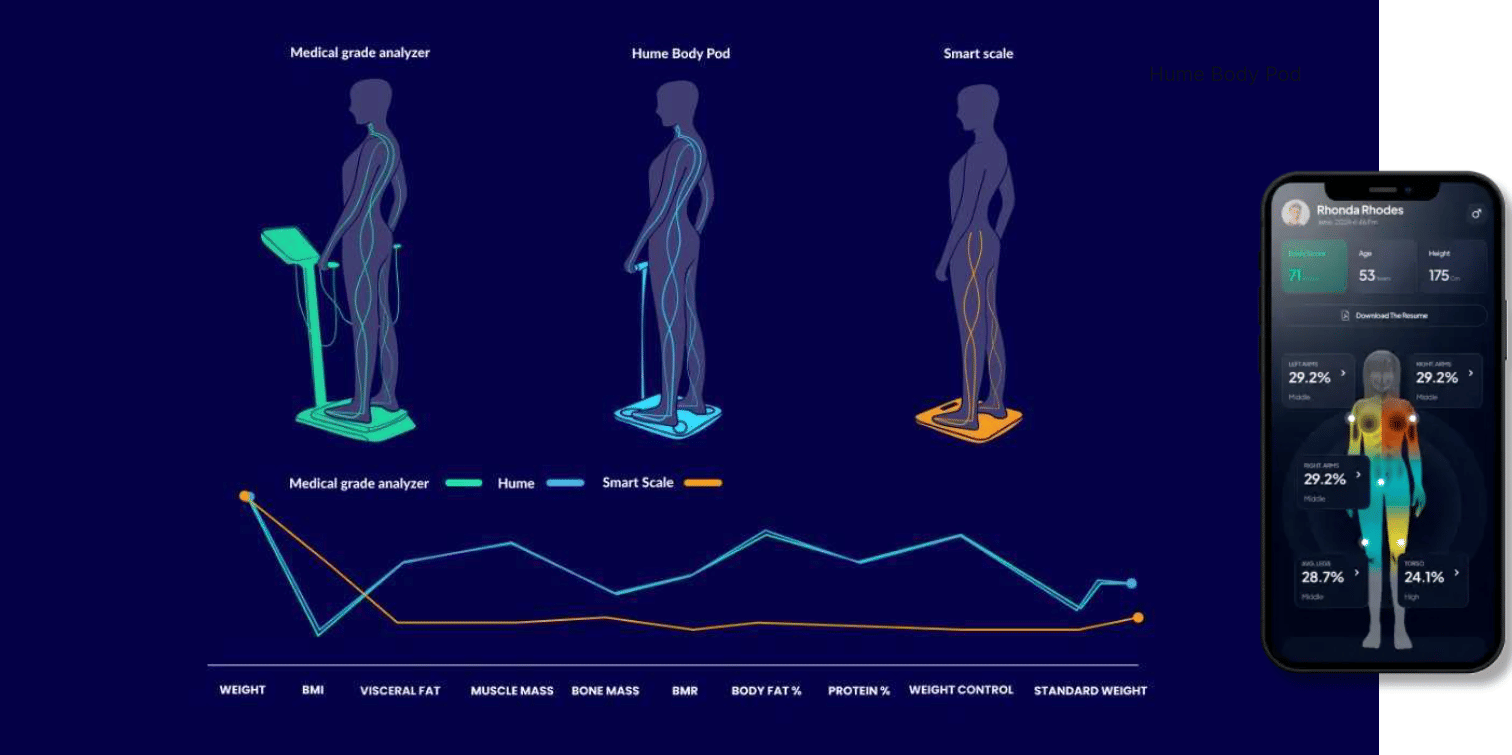
Hume Health heavily markets its hardware as being up to 98% as accurate as a Dual-Energy X-ray Absorptiometry (DEXA) scan—the golden medical standard for bone density and body fat evaluation.
In practice, any smart scale using Bioelectrical Impedance Analysis (BIA) is subject to environmental variables. The electrical current traveling through your tissue is highly sensitive to total body water content. If you step on the Body Pod immediately after drinking a large bottle of water, or right after an intense, sweaty workout, your body fat readings can shift by 1% to 3% within a matter of hours.
Therefore, while the Body Pod is highly precise for tracking long-term composition trends, you shouldn't view individual daily metrics as absolute clinical diagnostic truths.
Trust Capital and Corporate Backing
Hume Health products are HSA/FSA eligible, which serves as a solid trust signal indicating that their equipment meets standard regulatory criteria for health-saving account reimbursement. However, potential buyers should note that their customer service infrastructure can occasionally experience backlogs. Independent consumer platforms like Trustpilot showcase a mix of reviews, with specific complaints focused on shipping delays or delays in processing the 45-day money-back guarantee.
Customer Reviews & Ratings: What Real Users Say
The public consensus on Hume Health highlights a distinct split between the hardware functionality and the underlying customer service experience.
The Positive Consensus
Users who focus heavily on resistance training and muscle-building praise the Body Pod for its segmental mapping. Many fitness enthusiasts note that during periods where their overall weight plateaued on a standard scale, the Hume app successfully demonstrated that they were shedding body fat while adding lean muscle tissue, providing much-needed psychological motivation. The screenless design of the band is also highly praised by individuals looking to detach from constant smartphone notifications.
The Critical Feedback
Conversely, critical reviewers focus on software bugs and hardware connection drops. Several users highlight frustrations with the aggressive billing prompts for the Hume Plus subscription tier during initial setup. Others point out that the sleep architecture tracking can occasionally misclassify quiet awake time in bed as light sleep, making it slightly less precise for sleep optimizations compared to dedicated laboratory devices.
Who Should Use Hume Health?
Hume Health is not a one-size-fits-all solution for every consumer. Understanding your specific wellness goals will determine if it is the right addition to your home.
The Ideal Match:
- Longevity Seekers: Individuals over 35 who are focused on extending their healthspan, tracking internal visceral fat, and monitoring cardiovascular trends.
- Body Recomposition Enthusiasts: Bodybuilders, powerlifters, or everyday gym-goers who want to see exactly where they are adding muscle and losing fat across their limbs.
- Subscription-Weary Shoppers: People who want premium wearable metrics without committing to a mandatory, expensive monthly membership.
Who Should Skip It:
- Casual Weight Trackers: If you just want to know your general body weight once a week, a standard $20 digital scale is more than sufficient.
- Elite Training Athletes: Endurance athletes optimizing precise daily cardio training strains may still find the deep recovery and strain algorithms of a WHOOP band more tailored to their goals.
Final Verdict
Hume Health has successfully designed an impressive, forward-thinking health ecosystem with the Body Pod and Band. By integrating advanced 8-electrode segmental body mapping with a screenless, long-battery wearable, they have removed the financial barrier of ongoing monthly fees that plagues much of the modern health-tech space.
While the software ecosystem can still suffer from occasional bluetooth sync hiccups and the customer service response times have room for improvement, the underlying hardware delivers high-quality data trends. If you are committed to actively utilizing body composition tracking and long-term biometric insights to reshape your health habits, the Hume Health ecosystem stands out as an excellent, empowering investment for your longevity journey.
FAQs
1. Can I use the Hume Health Body Pod without a smartphone?
No. While the scale will calculate your basic body weight on its physical display, you need a compatible iOS or Android smartphone with the Hume Health App installed via Bluetooth to analyze, sync, and view the other 47 body composition metrics.
2. Is the Hume Health Band fully waterproof?
The Hume Health Band features an IP68 dustproof and water-resistant rating. This means it can easily handle daily sweat, intense workouts, heavy rain, and showers. However, it is generally recommended to avoid deep-water diving or prolonged exposure to high-velocity water streams.
3. How does the Body Pod calculate my biological age?
The app evaluates your calculated basal metabolic rate (BMR), total intracellular water retention, and total skeletal muscle-to-fat ratio. It then runs these custom metrics against generalized physiological health baselines to determine your estimated metabolic age.
4. Can individuals with a pacemaker use the Hume Body Pod?
No. Because the Body Pod passes a low-level, painless electrical current through your body to measure tissue resistance, individuals with pacemakers, internal defibrillators, or any other active implanted medical devices should avoid using the scale.
5. Does the Hume Band require a monthly subscription?
No. Unlike several major competitors, Hume Health provides a comprehensive free tier within their companion app that tracks your essential metrics. Upgrading to the premium Hume Plus subscription ($8.99/month) is entirely optional and unlocks advanced diagnostic trends and personalized coaching features.
Write a comment
Comments
No Comments Yet